Polysaccharides in Aloe and Sea Vegetables: What the Research Shows
Update to a previous link: Years ago, I saved and hosted a 2000 scientific review titled Heparinoid-active sulphated polysaccharides from marine algae as potential blood anticoagulant agents. You may have arrived at this article through a link to that old research paper. The paper examined sulfated polysaccharides from marine algae, including red, brown, and green algae, and research into their potential anticoagulant activity. More than 25 years have passed since that review was published, and we now have considerably more research on the structures of these compounds. I thought it was time to revisit the subject.
If you have spent much time reading about aloe vera or sea vegetables, sooner or later you are going to run into the word polysaccharides (saccharide meaning “sugar,” poly meaning “many”). Polysaccharides are complex carbohydrates made from chains of smaller sugar molecules joined together. They occur throughout nature. Aloe vera contains polysaccharides. Sea vegetables contain polysaccharides. Some polysaccharides from marine algae are sulfated, and certain isolated sulfated polysaccharides have demonstrated anticoagulant, or heparin-like, activity in laboratory research. Meaning polysaccharides aren’t interchangeable any more than all foods containing protein are interchangeable. Eggs, beans, and steak all contain protein, but they’re certainly not the same food.
Different polysaccharides can contain different sugars arranged in different sequences. They may be straight or branched. They can have different molecular weights and three-dimensional structures. Chemical groups can also be attached at different positions along the molecule.
Researchers studying biological activity care about which polysaccharide, its molecular structure, its molecular weight, the sugars it contains, how those sugars are linked, and what other chemical groups are attached to it.
Aloe Vera Is a Source of Polysaccharides
Aloe vera gel contains a mixture of compounds, including polysaccharides. One of the best-known is acemannan (pronounced “ace-man-nun”), an acetylated (don’t worry about it if you don’t know what that is; just think of it as something that can alter another thing on a molecular level) mannan commonly described as one of the major bioactive polysaccharides of Aloe vera. Researchers have spent years studying its structure as well as its potential biological properties.
Acemannan itself is a good illustration of why structure matters. Its biological characteristics can be influenced by features such as molecular weight and acetylation. Processing and extraction methods can alter those characteristics as well. In other words, even when two researchers both say they are studying “aloe polysaccharides,” they may not necessarily be studying chemically identical material.
Sea Vegetables Are Rich in Different Polysaccharides
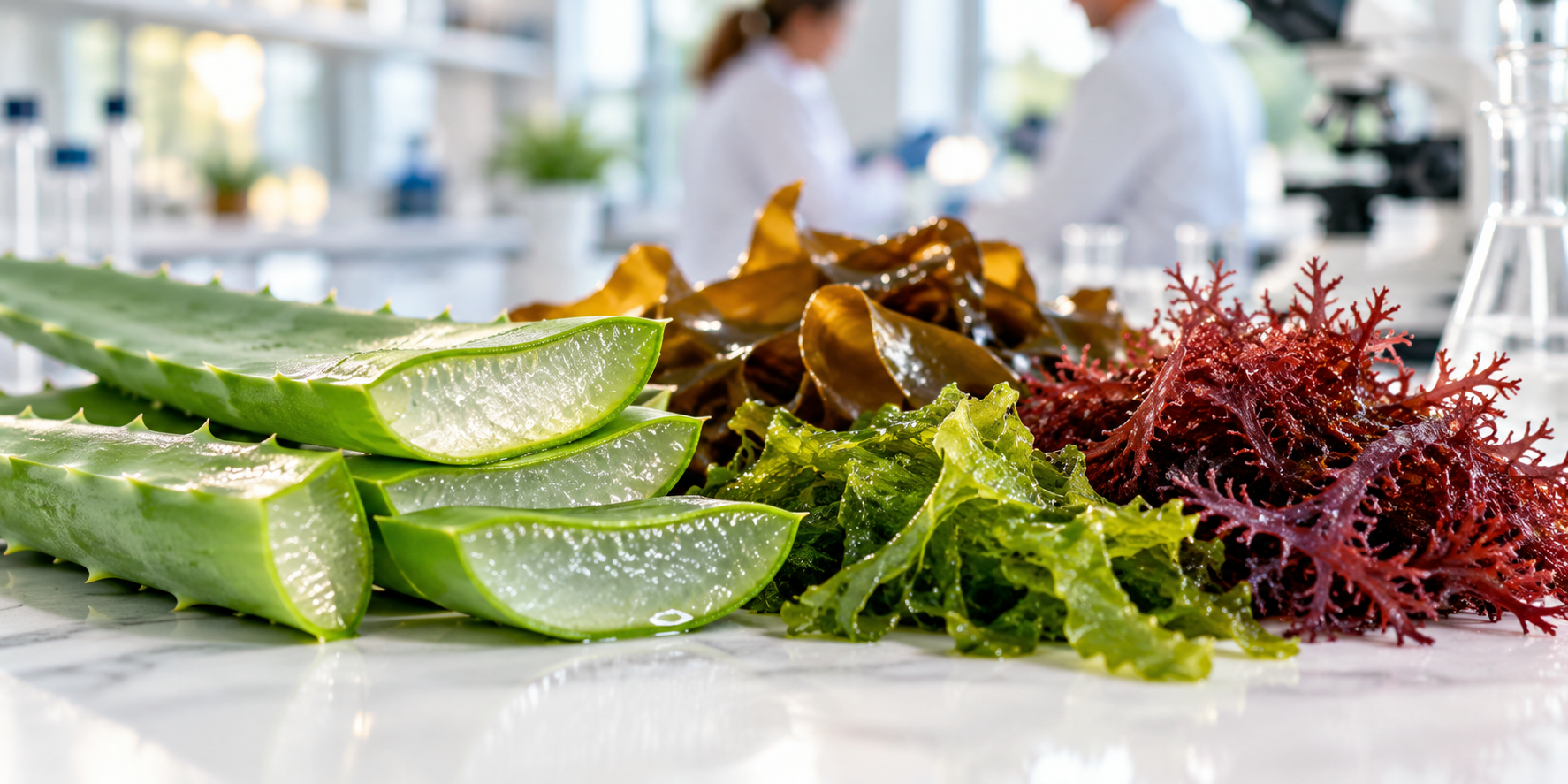
Moving away from what everyone calls their “burn plant” to the ocean, and the polysaccharide story becomes even more diverse. Marine algae, or seaweeds, are commonly divided into three broad groups: brown, red, and green algae. Each contains characteristic polysaccharides.
Brown seaweeds contain polysaccharides such as alginate (used as a thickener in foods like ice cream), laminarin (which has even been studied as a natural way of stimulating plants’ own defense response), and fucoidan (which researchers are investigating for drug delivery, including ways to protect medications as they pass through the stomach). Red seaweeds are known for compounds including agar (I use this if I’m trying to make something more gelatinous, or to smooth out some blended desserts) and carrageenan carrageenan (a substance used to help ingredients stay mixed and give foods a creamy mouthfeel that doesn’t use fat). Green seaweeds include polysaccharides such as ulvan (an interesting polysaccharide with antioxidant and antimicrobial properties that is being studied for non-petroleum-based food packaging films).
These compounds serve functions for the algae themselves, including structural roles in their cell walls. They are also chemically different from one another. This matters because some marine polysaccharides have another characteristic that has attracted a great deal of scientific attention: they are sulfated polysaccharides.
What Is a Sulfated Polysaccharide?
First, don’t confuse sulfate with the smelly sulfur compounds you may associate with rotten eggs. Sulfate is sulfur bonded to oxygen, and it doesn’t have that characteristic rotten-egg smell. A sulfated polysaccharide is simply a polysaccharide with sulfate groups attached to portions of its sugar structure. These compounds are particularly common in marine algae. Examples include the aforementioned fucoidans, carrageenans, and ulvans.
Researchers have studied sulfated polysaccharides from marine algae for a wide variety of potential biological activities. One of the oldest and most intriguing areas of research involves blood coagulation.
And this brings us back to that old paper I mentioned in the box above.
Why Researchers Compared Some Marine Polysaccharides With Heparin
Heparin is itself a highly sulfated polysaccharide. It is also a powerful anticoagulant drug. Researchers discovered decades ago that some isolated sulfated polysaccharides from marine organisms could affect blood coagulation in laboratory experiments. That led scientists to investigate what was sometimes described as their heparin-like or heparinoid activity.
Fucoidans and other sulfated fucans from brown seaweeds have received particular attention, but anticoagulant activity has also been reported in laboratory research involving sulfated polysaccharides isolated from certain red and green algae. Research has examined several possible mechanisms, including effects involving thrombin, antithrombin, and heparin cofactor II, all of which participate in the coagulation process.
This remains an active field of research. A 2024 scientific review examining sulfated polysaccharides with anticoagulant potential concluded that their activity is associated with multiple structural characteristics, including the position and degree of sulfation, molecular weight, side-chain structure, and the configuration of chemical bonds within the molecule.
That finding echoes an important point researchers were already making when the paper I saved was published in 2000: Structure matters.
A Sulfate Group Doesn’t Magically Turn a Polysaccharide Into Heparin
This is where a fascinating piece of research can turn into a very bad Internet health claim. The presence of sulfate groups alone does not determine whether a polysaccharide will have anticoagulant activity. Studies of marine sulfated polysaccharides have found that activity can vary with factors including:
- Molecular weight
- Sugar composition
- Degree of sulfation
- Position and distribution of sulfate groups
- Glycosidic linkages between sugars
- Branching and three-dimensional structure
Even closely related compounds can behave differently. This explains why we cannot take a laboratory finding involving a purified sulfated polysaccharide and automatically apply it to the whole seaweed from which it came.
Does That Mean Eating Seaweed Has an Anticoagulant Effect?
No! That conclusion would go well beyond the evidence. A laboratory experiment using an isolated compound is very different from eating a sea vegetable. Extraction and purification can concentrate particular molecules, and laboratory studies may use amounts and conditions that bear little resemblance to normal dietary exposure.
There is even a small human study that illustrates the problem nicely. Researchers gave 10 volunteers a fucoidan preparation and another 10 a placebo for 12 days. Fucoidan had shown strong anticoagulant activity in laboratory testing, but its effect on blood clotting when taken orally was not clear. The researchers concluded that the particular fucoidan preparation they tested did not appear to have oral anticoagulant activity, possibly because very little was absorbed from the intestine.
That distinction matters. Activity in a test tube does not automatically tell us what will happen when a person eats a food or swallows a supplement. Digestion, absorption, metabolism, dose, molecular size, and bioavailability all enter the picture.
So when we say that certain sulfated polysaccharides isolated from marine algae have demonstrated anticoagulant or heparin-like activity, we are describing the research on those particular compounds. We are not saying that seaweed is a natural version of heparin. It isn’t.
So What Does Aloe Have to Do With Any of This?
Aloe vera is not being included here because it contains the particular marine polysaccharides discussed above. It doesn’t. Aloe belongs in this story because it gives us another excellent example of just how diverse polysaccharides can be.
Aloe contains polysaccharides such as acemannan. Brown, red, and green seaweeds contain their own characteristic polysaccharides. Some marine polysaccharides are sulfated. Some of those sulfated polysaccharides have demonstrated particular biological activities under experimental conditions.
The word polysaccharide connects them. Their chemistry distinguishes them. Understanding both sides of that sentence is far more useful than treating “polysaccharides” as though it were the name of one miraculous ingredient.
The Bigger Lesson: Nature Doesn’t Read Marketing Copy
I’ve worked with Body Balance for many years, and its ingredient story brings aloe vera and a blend of sea vegetables together in the same product. So when I began coming across research into the polysaccharides found in aloe and marine algae, it naturally caught my attention. The old research paper on heparinoid-active sulfated polysaccharides from marine algae was one small part of that curiosity. Today I think the larger story is more interesting.
Researchers continue to investigate aloe polysaccharides, marine sulfated polysaccharides, fucoidans, ulvans, carrageenans, and many other complex carbohydrates because their structures and biological interactions are remarkably diverse.
Some findings may eventually lead to useful medical or nutritional applications. Others may remain interesting laboratory observations. Good science means being willing to tell the difference.
Your TL;DR
- Aloe vera and sea vegetables both contain polysaccharides.
- Those polysaccharides are not all the same.
- Aloe is particularly associated with mannans such as acemannan, while marine algae contain a broad range of polysaccharides that vary among brown, red, and green seaweeds.
- Some marine algae also contain sulfated polysaccharides.
- Certain isolated sulfated polysaccharides have demonstrated anticoagulant or heparin-like activity in experimental research, and scientists continue to investigate how molecular weight, sulfate content and position, sugar composition, and overall molecular structure influence that activity.
None of this means that eating seaweed is equivalent to taking an anticoagulant medication. Nor does research on isolated polysaccharides establish an anticoagulant effect for a finished nutritional product containing sea vegetables.
References
References
Liu C, Cui Y, Pi F, et al. Extraction, Purification, Structural Characteristics, Biological Activities and Pharmacological Applications of Acemannan, a Polysaccharide from Aloe vera: A Review. Molecules. 2019;24(8):1554.
Polat S, Ozogul Y. Bioactive polysaccharides from seaweeds: applications, mechanisms, and toxicological insights. Food Chemistry. 2026;501:147600. doi:10.1016/j.foodchem.2025.147600.
Jiao G, Yu G, Zhang J, Ewart HS. Chemical Structures and Bioactivities of Sulfated Polysaccharides from Marine Algae. Marine Drugs. 2011;9(2):196–223.
Aziz A, Poinssot B, Daire X, et al. Laminarin elicits defense responses in grapevine and induces protection against Botrytis cinerea and Plasmopara viticola. Molecular Plant-Microbe Interactions. 2003;16(12):1118–1128. doi:10.1094/MPMI.2003.16.12.1118.
Cunha L, Grenha A. Sulfated Seaweed Polysaccharides as Multifunctional Materials in Drug Delivery Applications. Marine Drugs. 2016;14(3):42. doi:10.3390/md14030042.
Wang H, Cao Z, Yao L, et al. Insights into the Edible and Biodegradable Ulvan-Based Films and Coatings for Food Packaging. Foods. 2023;12(8):1622. doi:10.3390/foods12081622.
Chen Q, Zhang M, Liu Y, et al. Sulfated Polysaccharides with Anticoagulant Potential: A Review Focusing on Structure-Activity Relationship and Action Mechanism. Chemistry & Biodiversity. 2024;21(6). doi:10.1002/cbdv.202400152.
Irhimeh MR, Fitton JH, Lowenthal RM. Pilot clinical study to evaluate the anticoagulant activity of fucoidan. Blood Coagulation & Fibrinolysis. 2009;20(7):607–610.
Shanmugam M, Mody KH. Heparinoid-active sulphated polysaccharides from marine algae as potential blood anticoagulant agents. Current Science. 2000.
Research and Health Information: Research references are provided for educational purposes. Citation of a study, author, journal, or research institution does not imply endorsement of LiquidWholeFood or any product sold or discussed on this site. The information provided in this article is for educational purposes only and is not intended as medical advice or as a substitute for advice from a qualified healthcare professional. It is not intended to diagnose, treat, cure, or prevent any disease.