Ashwagandha and Stress: What Does the Research Show?
A Note About This Article: Years ago, I saved and hosted a 2008 clinical study titled A Standardized Withania Somnifera Extract Significantly Reduces Stress-Related Parameters in Chronically Stressed Humans: A Double-Blind, Randomized, Placebo-Controlled Study. Because research has advanced considerably since that paper was published, we’ve replaced the old PDF resource with this updated look at the evidence. The original study remains an important part of the research history, but it can now be understood in the context of a much larger body of evidence.
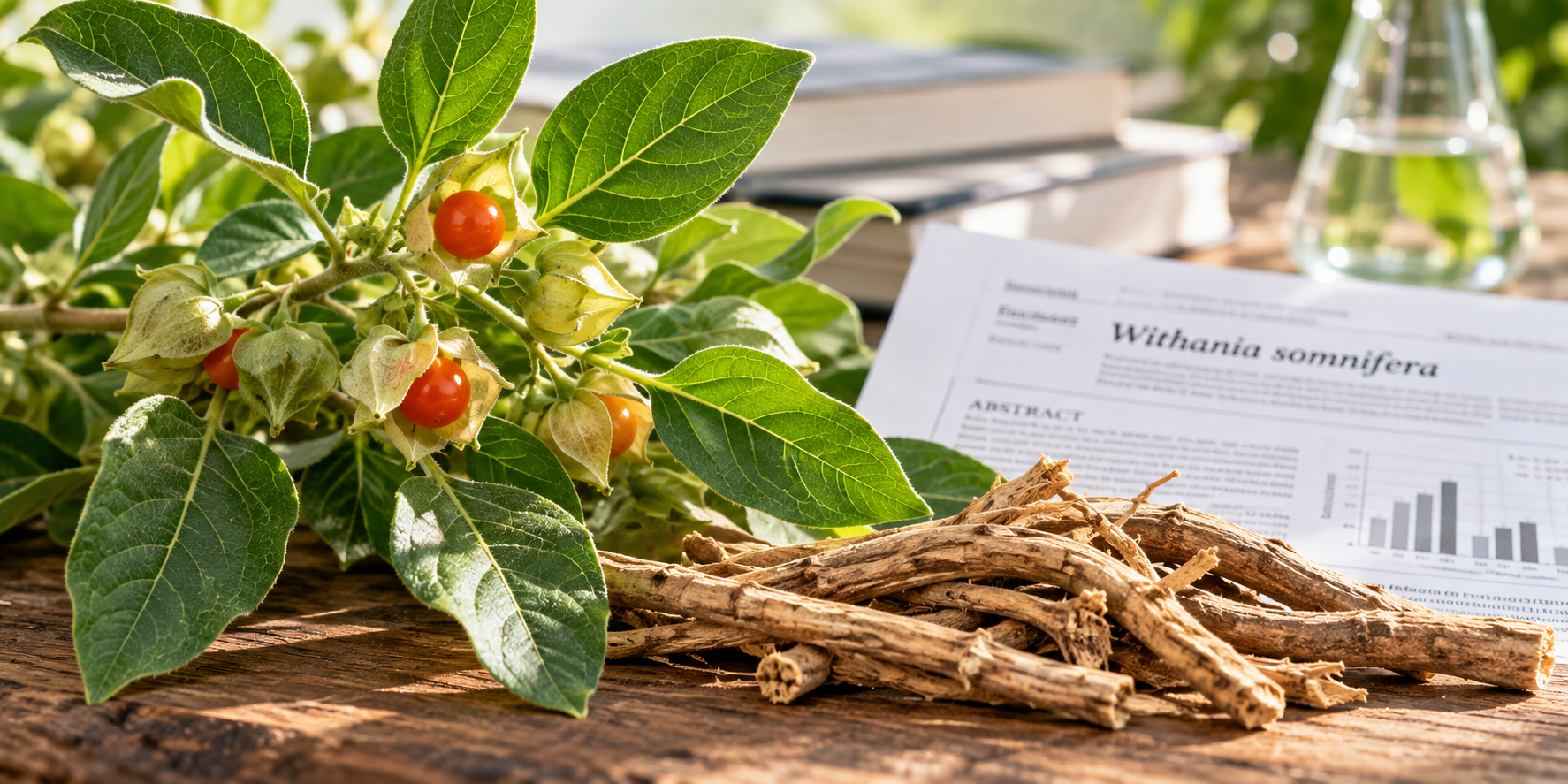
Stress isn’t exactly a new human experience. Neither is ashwagandha. Withania somnifera, better known as ashwagandha, has been used in traditional Ayurvedic medicine for centuries. Today, you’ll often hear it described as an adaptogen, a term used for substances believed to help the body respond and adapt to stress. But ashwagandha has something many traditional remedies don’t have: a growing body of modern human research behind it.
Nearly 20 years ago, we saved a clinical study examining ashwagandha and chronic stress to the LiquidWholeFood research library. At the time, it was an intriguing piece of research. A lot has happened since then. Researchers have continued studying ashwagandha in randomized controlled trials. They’ve measured perceived stress and anxiety, but they’ve also looked at cortisol and other physiological measures. And we now have systematic reviews and meta-analyses that allow researchers to look at the results of multiple clinical trials together. After almost two more decades of research, what do we know now?
The Study That Started This Conversation
The paper we’d saved was published in 2008 and had a title only a researcher could love:
“A Standardized Withania Somnifera Extract Significantly Reduces Stress-Related Parameters in Chronically Stressed Humans: A Double-Blind, Randomized, Placebo-Controlled Study.”
Researchers enrolled 130 adults experiencing chronic stress and randomly assigned them to receive one of three doses of a standardized Withania somnifera root-and-leaf extract or a placebo for 60 days. Ninety-eight participants completed the study. And they didn’t just ask everyone, “So, do you feel less stressed?” They used a modified Hamilton Anxiety Scale to evaluate symptoms and also measured biological and clinical variables including cortisol, DHEAS, C-reactive protein, fasting blood glucose, cholesterol, triglycerides, blood pressure, and pulse rate.
The results were striking. Participants receiving the ashwagandha extract showed substantial improvements in stress and anxiety scores compared with placebo. The researchers also reported reductions in cortisol in all three ashwagandha groups, along with changes in several other measured markers. Some results appeared dose-dependent.
What Happened Over the Next 18 Years?
More randomized controlled trials followed. Then enough trials accumulated for researchers to begin combining their results in systematic reviews and meta-analyses. That’s particularly useful because instead of asking what happened in one group of 50 or 100 people, researchers can look for patterns across hundreds or even thousands of participants.
A 2022 systematic review and meta-analysis gathered 12 randomized controlled trials involving 1,002 people. Taken together, the trials showed significant reductions in both stress and anxiety scores among people taking ashwagandha compared with controls.
A 2024 meta-analysis looked at nine randomized controlled trials with 558 participants. Again, the combined evidence favored ashwagandha. Researchers found significant improvements in perceived stress scores and anxiety scores.
And there was another interesting finding: Cortisol decreased, too. That matters because perceived stress is inherently subjective. Cortisol isn’t a perfect measurement of “how stressed” someone is, but seeing changes in both reported experience and a physiological component of the stress response makes the findings more interesting.
Not every analysis has found the same pattern. A 2025 meta-analysis found a significant reduction in cortisol but not in perceived-stress scores, suggesting that changes in a biological stress marker don’t necessarily translate neatly into how stressed someone feels.
Most recently, a 2026 systematic review and dose-response meta-analysis examined 22 randomized controlled trials. It again found significant improvements in stress and anxiety and also found an effect on depressive symptoms.
What Could Ashwagandha Be Doing?
Stress isn’t simply a feeling. It involves a coordinated physiological response, including the hypothalamic-pituitary-adrenal (HPA) axis, which helps regulate the body’s response to stress and influences cortisol production. The authors of that original 2008 study were already looking in this direction. They proposed that ashwagandha’s effects might involve regulation of the HPA axis and noted changes in cortisol and DHEAS among participants receiving the extract.
Subsequent research has continued investigating ashwagandha’s possible effects on stress-response pathways. That doesn’t mean we’ve mapped out one tidy mechanism in which ashwagandha flips a “stress switch” off. Human stress biology is considerably more complicated than that. But the combination of reported improvements in stress plus measurable physiological changes is one reason ashwagandha continues to attract scientific interest.
Stress, Anxiety, and Sleep
Ashwagandha has also been studied for anxiety and sleep. The results for stress are currently the most convincing. The National Center for Complementary and Integrative Health says some ashwagandha preparations may be effective for stress and insomnia, although it considers the evidence for anxiety less clear. That distinction is worth making. Stress and anxiety overlap, but they aren’t interchangeable, either in everyday life or in clinical research. Still, when several meta-analyses find improvements in anxiety measures alongside the stress findings, it’s reasonable to say there’s a signal worth investigating further.
Not All Ashwagandha Is Identical
The clinical studies haven’t all used the same thing. Researchers have studied different extracts, different doses, root alone versus root-and-leaf preparations, and products standardized to different concentrations of naturally occurring compounds such as withanolides. That’s important when interpreting the research. A successful trial of one standardized extract doesn’t guarantee that every bottle labeled “ashwagandha” will produce an identical result.
But it doesn’t erase the larger pattern, either. When different randomized trials using different preparations repeatedly produce results pointing in a similar direction, that pattern itself becomes scientifically interesting.
And Yes, Safety Still Matters
Ashwagandha has generally been well tolerated in short-term clinical trials, and the NIH Office of Dietary Supplements says it appears to be well tolerated for up to about three months. Common reported side effects include digestive upset and drowsiness. Rare cases of liver injury have also been reported. Ashwagandha may affect thyroid function and may interact with certain medications.
It’s also not appropriate for everyone, including during pregnancy and breastfeeding, and there are additional cautions for people with certain thyroid, autoimmune, and other medical conditions. So this is still a botanical with biological activity, not an herb to take indiscriminately because somebody on TikTok put it in a smoothie.
So, Does Ashwagandha Help With Stress?
After nearly two decades of additional research, I think the answer is more interesting than “maybe.”
There is now a meaningful body of human clinical evidence suggesting that certain ashwagandha preparations can reduce measures of stress.
That’s supported not by one old study, but by multiple randomized controlled trials and several systematic reviews and meta-analyses. We still don’t know everything we’d like to know. We need better long-term safety data. Researchers haven’t settled on an ideal preparation or dose. And the evidence for some uses, such as anxiety, isn’t as settled as the evidence for stress.
The little 2008 study we saved all those years ago didn’t settle the question. It helped start one, and almost 20 years later, researchers are still finding that it’s a question worth asking.
This is a full copy of a paper I have had on the site since 2013, to provide additional background: An Overview on Ashwagandha: A Rasayana (Rejuvenator) of Ayurveda, bySingh N, Bhalla M, de Jager P, Gilca M. (African Journal of Traditional, Complementary and Alternative Medicines. 2011;8(5 Suppl):208–213)
You can find Ashwagandha in our Female Hormonal Support, Life Balance Menopause Support, and TrueCleanse products.
References
- Auddy B, Hazra J, Mitra A, Abedon B, Ghosal S. A Standardized Withania Somnifera Extract Significantly Reduces Stress-Related Parameters in Chronically Stressed Humans: A Double-Blind, Randomized, Placebo-Controlled Study. JANA. 2008;11(1):50–56
- Akhgarjand C, et al. Does Ashwagandha supplementation have a beneficial effect on the management of anxiety and stress? A systematic review and meta-analysis of randomized controlled trials. Phytotherapy Research. 2022;36(11):4115–4124
- Arumugam V, et al. Effects of Ashwagandha (Withania somnifera) on stress and anxiety: A systematic review and meta-analysis. Explore. 2024;20(6):103062
- Fatima K, et al. Safety and efficacy of Withania somnifera for anxiety and insomnia: systematic review and meta-analysis. Human Psychopharmacology. 2024;39(6):e2911
- Albalawi AA. Dual impact of Ashwagandha: Significant cortisol reduction but no effects on perceived stress – a systematic review and meta-analysis. Nutrition and Health. 2025;31(4):1395–1408
- Alsanie SA, Alhodieb FS, Askarpour M. Effects of ashwagandha (Withania somnifera) on mental health in adults: a systematic review and dose-response meta-analysis of randomized controlled trials. Complementary Therapies in Medicine. 2026;103325
- National Center for Complementary and Integrative Health. Ashwagandha: Usefulness and Safety
- NIH Office of Dietary Supplements. Ashwagandha: Is it helpful for stress, anxiety, or sleep?
Research and Health Information: Research references are provided for educational purposes. Citation of a study, author, journal, or research institution does not imply endorsement of LiquidWholeFood or any product sold or discussed on this site. The information provided in this article is for educational purposes only and is not intended as medical advice or as a substitute for advice from a qualified healthcare professional. It is not intended to diagnose, treat, cure, or prevent any disease.